Vertical desanders and desilters are core equipment in oil drilling, river dredging, and wastewater treatment for achieving solid-liquid separation and ensuring liquid purity. Although both utilize centrifugal force for operation, there are significant differences in treatment precision, structural design, and application focus.
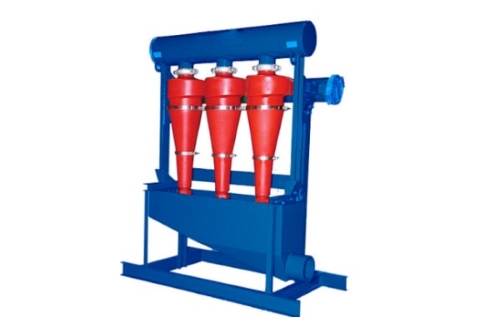
Differences in Treatment Precision and Particle Diameter
The most fundamental difference between the vertical desander and desilting equipment lies in their “fineness.” In the solids control process, these two typically occupy different stages of purification.
- Desilting Precision: The vertical desander focuses on processing fine particles ranging from 5-74μm, with a desilting efficiency of 85%-95%.
- Desanding Precision: In contrast, equipment such as the MD300 vertical desander primarily handles coarser solid particles between 40-100μm.
- Application Logic: Usually, the desander performs the initial screening and cleaning, followed by the desilter which completes the subsequent fine purification.
Advantages of Structural Design and Space Utilization
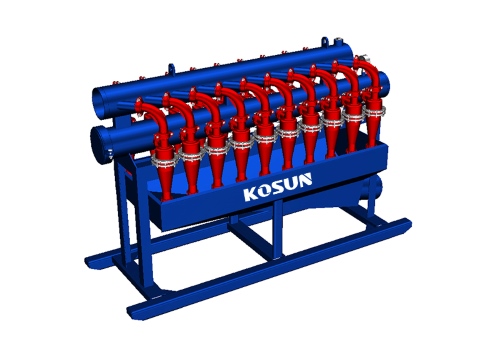
The vertical desander designed by KOSUN has undergone deep structural optimization, fully considering the complex environments of construction sites.
- Vertical Structure: The vertical layout greatly saves installation space, making it particularly suitable for working conditions with narrow sites and high equipment density.
- Modular Integration: The compact equipment size makes it easy to integrate into skid-mounted systems, meeting the needs for rapid transition and flexible deployment.
- Material Customization: Depending on the corrosiveness and abrasiveness of the materials, liners can be customized with polyurethane, high-chromium cast iron, wear-resistant ceramics, or stainless steel.
Working Principle and Energy Consumption Performance
The vertical cyclone desilter relies on the pressure of the fluid itself to drive it, making it a typical energy-saving and high-efficiency solid-liquid separation device.
- Centrifugal Separation: The liquid mixture enters the cyclone tangentially, and the centrifugal force generated by high-speed rotation flings the heavy-phase particles toward the wall.
- Automatic Discharge: Dense particles slide down the cone to the underflow port for discharge, while the clean liquid flows out from the top overflow port.
- Flexible Regulation: Users can precisely control the separation particle size and optimize the treatment effect by adjusting the feed pressure and underflow port size.
Comparison of Extensive Application Fields
Depending on the different properties of the materials processed, the vertical cyclone desilter demonstrates strong multi-scenario adaptability and serves various industries.
- Energy Extraction: Used for the purification of oil and gas drilling fluids, thoroughly removing fine drill cuttings to protect drilling pumps and downhole tools.
- Environmental Engineering: Achieves turbidity reduction and solid-liquid separation in river dredging and industrial wastewater treatment to meet government emission standards.
- Industrial Manufacturing: Suitable for ore pulp classification, tailings thickening in mining, and fine filtration of chemical raw materials such as chemical slurries.
Summary
The choice between a vertical desanders and a desilter primarily depends on your requirements for material particle diameter treatment precision. If you are facing high mud content, limited space, and the need to capture micron-level suspended solids, the vertical cyclone desilter is undoubtedly the more professional and economical choice.