
Fine colloidal solids degrade drilling fluid properties and drive up operating cost. Selecting a decanter centrifuge that removes them effectively — and deciding between fixed-speed and variable-frequency drive (VFD) configurations — is a core engineering decision for field managers. The two drive setups differ in fluid dynamics, processing range, and operator control, and each fits a different set of field conditions. KOSUN outlines the technical differences and the selection logic behind each.
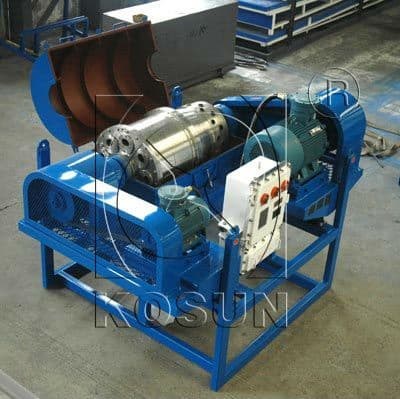
Fixed-speed configuration
In a fixed-speed decanter centrifuge, fixed gear ratios drive the bowl and the internal conveyor screw at constant, preset speeds. Because the ratio cannot be changed in the field, the machine is configured for one of two operating modes, and the choice between them is made at specification stage rather than on site.
In low-speed operation, the unit concentrates primarily on real-time barite recovery during drilling, preventing the loss of expensive weighting agents. In high-speed operation, it runs continuously at its upper velocity limit to provide secondary and tertiary solids control, systematically separating fine colloidal contaminants larger than 2 microns.
This configuration performs best in standard onshore drilling campaigns with predictable geological formations and minimal mud density fluctuations. It is a highly cost-effective, classic choice for remote jobsites with limited budgets that demand high mechanical availability and simplified operator controls.
VFD configuration
A VFD decanter centrifuge integrates an intelligent, centralized variable-frequency drive control system. It eliminates rigid mechanical speed limits, allowing crews to adjust bowl velocities seamlessly across a broad range from 0 to 3900 RPM.
This flexibility makes the VFD configuration ideal for demanding operations, including extended-reach wells, oil-based mud (OBM) loops, and zero-discharge projects.
Moreover, automated torque tracking responds to sudden changes in slurry solids concentration and non-Newtonian flow behavior. It adjusts differential speed and centrifugal force in real time. As a result, the system optimizes retention time inside the bowl.
Heavy-duty engineering across both configurations
Regardless of the chosen drive configuration, KOSUN manufactures every heavy-duty decanter centrifuge to the same rigid engineering standards.
Wear-resistant materials protect key components against severe erosion. The cone discharge ports feature replaceable tungsten carbide inserts. Meanwhile, the conveyor screw faces are fully covered with hard-faced tungsten carbide tiles. The rotational core integrates premium bearings sourced strictly from SKF or FAG to maximize mechanical uptime. For fluid handling, the system supports progressive cavity and submersible slurry pumps. This ensures continuous feeding while minimizing shear damage to the active drilling mud.
Conclusion
Choosing the right decanter centrifuge drive for your field conditions ensures stable solids control. It also helps protect your valuable drilling fluid investment. Fixed-speed configurations suit predictable formations, remote sites, and budget-constrained campaigns where simplified controls and high mechanical availability matter most. VFD configurations are ideal for complex wells, OBM loops, and zero-discharge projects. They adapt to changing slurry conditions and allow real-time retention time adjustments.
Xi’an KOSUN Machinery Co., Ltd. builds both configurations to the same heavy-duty specifications.Each unit also features tungsten carbide wear protection, SKF/FAG bearings, and a shear-free feeding system, ensuring reliable operation and extended service life. Contact KOSUN with your mud properties, solids loading, and discharge requirements to specify the right decanter centrifuge drive configuration for your operation.