
The KD-200 Slurry Treatment System resolves space limits and long teardown cycles for small-to-medium slurry balance shield projects. It delivers high-efficiency, real-time purification within a very tight structural footprint. As municipal pipeline construction extends into dense urban zones, traditional large multi-tank plants become impossible to deploy due to site constraints. Therefore, this KD-200 Slurry Treatment System utilizes a containerized assembly process. It integrates a scalping shaker, hydrocyclone classification manifolds, feed pumps, and storage tanks onto a single steel skid base, providing a low-consumption, highly mobile fluid recovery solution for modern trenchless projects.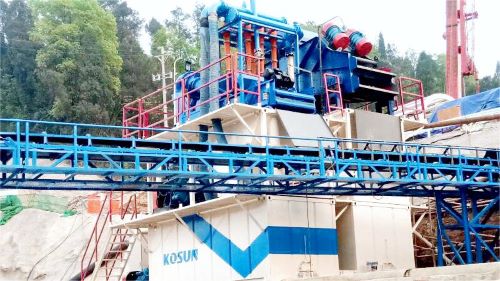
Process Workflows and Staged Separation of the KD-200 Slurry Treatment System
Although the system features a highly condensed structure, the internal fluid dynamics chain remains extremely strict. This design allows the KD-200 Slurry Treatment System to maintain a massive instantaneous throughput within a minimized space:
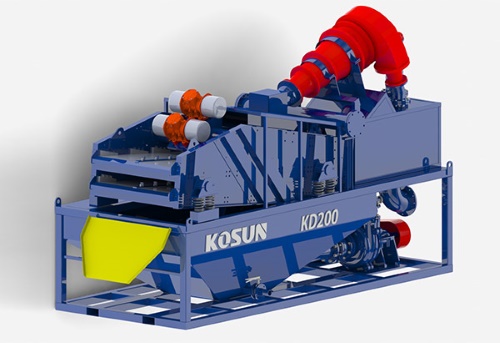
- Primary Screening and Interception: Raw high-viscosity slurry returning from the tunnel face first flows across a large-area scalping shaker. This stage rapidly extracts large stones and cohesive muck blocks.
- Secondary Desanding and Centrifugal Classification: Next, a heavy-duty centrifugal pump injects the filtered fluid into the desanding module. Equipped with a large-diameter hydrocyclone, this module uses a high-acceleration centrifugal field to separate coarse sand solids quickly.
- Tertiary Desilting and Colloidal Removal: To prevent ultra-fine abrasive particles from eroding the shield thrusters and downstream high-pressure pumps, the fluid enters a fine desilter split-manifold assembly. This multi-cone configuration performs deep micro-particle separation to polish the active mud.
Flexible Regulation for Diverse Geological Formations
Urban geological strata exhibit high unpredictability. To satisfy the material balance requirements of different formations, such as high-plasticity clay or heavy gravel layers, the KD-200 Slurry Treatment System provides strong adjustable flexibility. Operators can tune the vibrating screen excitation force, screen deck angle, and mesh size in real time during continuous drilling operations.
By matching different D50 cut points, the setup adapts dynamically to various processing tasks, minimizing non-productive maintenance downtime. Furthermore, the overall power design remains highly conservative. This remote solution integrates seamlessly with local municipal grids or matches onboard generator sets in remote tunneling sectors.
Conclusion
Modern environmental regulations transform fluid processing from simple single-stage screening into a highly flexible control unit. Implementing this containerized, rapid-deployment KD Slurry Treatment System provides international contractors with an essential tool to optimize operational expenditure (OPEX) while securing strict environmental compliance.