
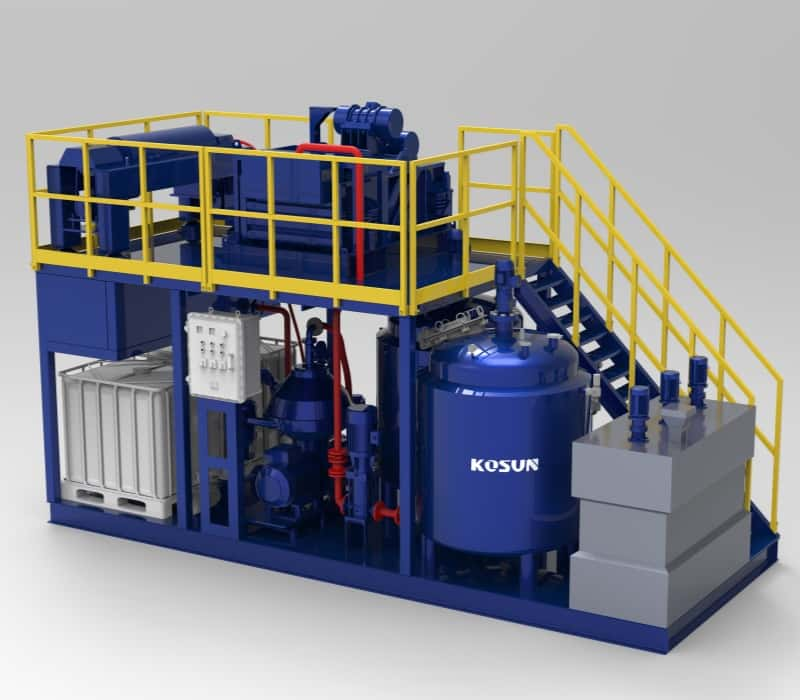
Oily sludge carries a hidden cost structure that many operations only recognize after the invoice arrives. Landfill tipping fees, incineration charges, and hazardous waste transport all scale with volume and oil content — meaning the more oil left in the solids, the more the disposal costs. KOSUN’s 1m³/h Integrated Oily Sludge Treatment System approaches the problem from the opposite direction: recover the oil, recycle the water, and shrink the waste stream so that what remains is cheaper to handle.
The Economics of Leaving Oil in the Solids
Traditional disposal methods — landfilling or incineration — are not only cost-prohibitive but also impose significant environmental burdens. As regulations tighten and hazardous waste disposal fees climb, the gap between “treat it” and “pay for it” widens every year.
The calculation is straightforward. Solids with high oil content command higher disposal fees, require more careful handling, and carry greater environmental liability. Solids with oil content below 2% qualify for standard hazardous waste landfill requirements — a materially cheaper category. The difference is not marginal; it is the core of the system’s business case.
Stage One: Chemical Hot Washing
The system’s first stage is where the economics begin. KOSUN’s chemical hot washing technology is far more than a high-temperature rinse. It applies proprietary surfactants and cleaning agents under precisely controlled thermal conditions to destabilize the stubborn “water-oil-solid” emulsified structures that hold oil against solid particles.
By neutralizing the adhesion between crude oil and the solid matrix, the process liberates oil that would otherwise be locked into the waste stream. A clean feedstock then moves to the separation stage.
Stage Two: Three-Phase Centrifugal Separation
Following the hot wash, the mixture passes through high-efficiency multi-stage centrifugal units — decanter and disc centrifuges — where an optimized centrifugal force field delivers precision three-phase separation.
Each output stream has a distinct economic role:
Recovered crude oil maintains high purity and can be sold directly as refinery feedstock, generating immediate revenue from what was previously a disposal liability.
Purified water returns to the system’s washing and heating stages in a closed-loop cycle — cutting freshwater consumption and eliminating wastewater discharge fees.
Treated solids reach oil content below 2% , qualifying for standard landfill requirements and substantially lowering downstream disposal costs and environmental liability.
Why the Payback Is Faster Than Alternatives
A standout feature of the KOSUN system is its Capital Expenditure (CAPEX) advantage combined with accelerated Return on Investment (ROI) .
Engineers designed the system for stable operation with tightly controlled energy and chemical consumption — two cost categories that erode returns in less disciplined designs. Recovered oil also generates revenue from day one, so payback shortens considerably versus high-investment processes like incineration or thermal desorption.
The distinction matters at the procurement stage. A lower-cost entry point with faster payback changes the investment’s financial risk profile. This matters especially for operations running multiple sites or treating intermittent waste streams.
Where the System Fits
The KOSUN 1m³/h Oily Sludge Treatment System handles a wide range of oily waste streams across oilfields, storage facilities, and petrochemical plants:
- Surface oily sludge from oilfield operations and equipment leakages
- Waste Oil-Based Mud (OBM) and drill cuttings from drilling activities
- Tank bottoms and sludge from storage tank and tanker cleaning
- Sediment and oily silt from wastewater basins and emergency pits
In each case, the value proposition stays the same. Recover what has value. Reduce what you must dispose of. Avoid paying for oil content you could have sold.
The Bottom Line
Choosing the KOSUN 1m³/h Oily Sludge Treatment System commits you to a green, efficient, and sustainable future — and to a financial decision grounded in disposal economics. The system recovers crude oil for refinery feedstock, closes the water loop, and cuts solids oil content below 2%. In doing so, it turns an unavoidable waste expense into a manageable, partly recoverable cost.
For enterprises seeking to balance environmental stewardship with economic profitability, that balance is where the system earns its place.